
Mothership Connection - Parliament
By: Ian Hoffman
Sunday School
MOTHERSHIP CONNECTION
Sunday School takes another look at a classic album worth revisiting years after its release. EMMIE staff handpick releases that shaped a genre, defined a generation or deserve a little more recognition. Keep up with Sunday School for your weekly dose of dusted-off classics + throwbacks that merit a second spin.
The civil rights movement was a passionate breath of optimism for African-Americans in the United States, but by the early ‘70s, this bright future waned into a police state where Black liberation was uncertain. The activists of the past had paved the way for progress, but the specific shape of a liberated future remained elusive in a society still gripped by systemic pushback. Concurrently, James Brown and Sly Stone had developed a funk movement that fostered a Black identity on top of the music prowess of soul and blues. While these important musicians created the basis of funk, it was George Clinton who pushed funk into a new world: both literally and figuratively.
Clinton visualized this disconcerting truth, "we had put Black people in situations nobody ever thought they would be in, like the White House. I figured another place you wouldn't think Black people would be was in outer space.”
Clinton organized dozens of musicians into a touring powerhouse of radical psychedelia known simply as Parliament-Funkadelic, or rather, P-Funk. This collective spawned groups like the Brides of Funkenstein, Bootsy’s Rubber Band, Parlet and of course the core pillars Parliament and Funkadelic.
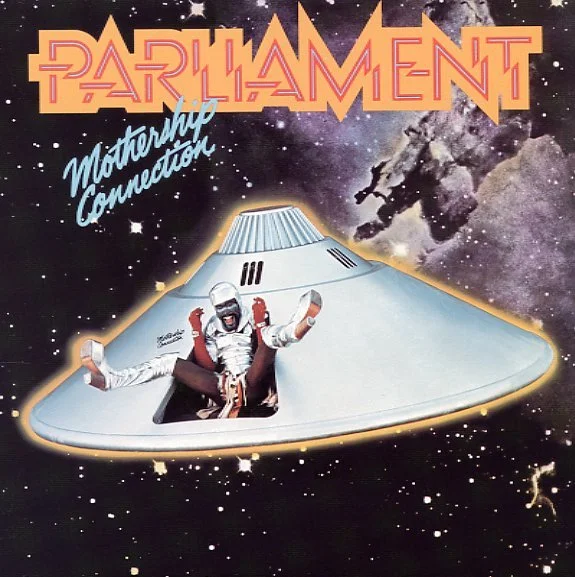
The consummation of P-Funk resulted in the collective’s first and definitive album, Mothership Connection. The record imagined a reality in which funk is ushered onto Earth by Clinton’s various alter egos, beamed straight from the mothership that he emerges from in the cover. This afrofuturist mythology pictured Black culture at the boundaries of human capability, a dream in which African-Americans are present in places that they weren’t in this post-segregated society.
The opening track P-Funk (Wants To Get Funked Up) starts with a reference to the overwhelmingly white sci-fi anthology The Outer Limits: Clinton effectively ‘decolonizes’ the show by instead having Lollipop Man (an alter ego of Clinton) take control of the listeners’ radio and proclaim that “funk not only moves, it can re-move.” Clinton’s lyrics suggest that P-Funk is not just music, but almost a religious experience brought by aliens to Earth for the purpose of partying and grooving.
Mothership Connection would not be quite as timeless without the performances of the Parliament-Funkadelic collective that featured Clinton emerging from a thousand-pound aluminum mothership live on stage to the shock of viewers. The no-expenses-spared performances of P-Funk not only reinforced the afrofuturist mythology, but was an example of the increasing capability of Black experimentation to see tangible success in America.
George Clinton’s influence on modern music cannot be overstated. Integrating social themes in an electrifying genre, he laid the groundwork for hip-hop and the Mothership Connection provides not only enduring tracks, but an expansion of the possibilities for African-Americans in contemporary culture, on Earth and across the galaxy.