
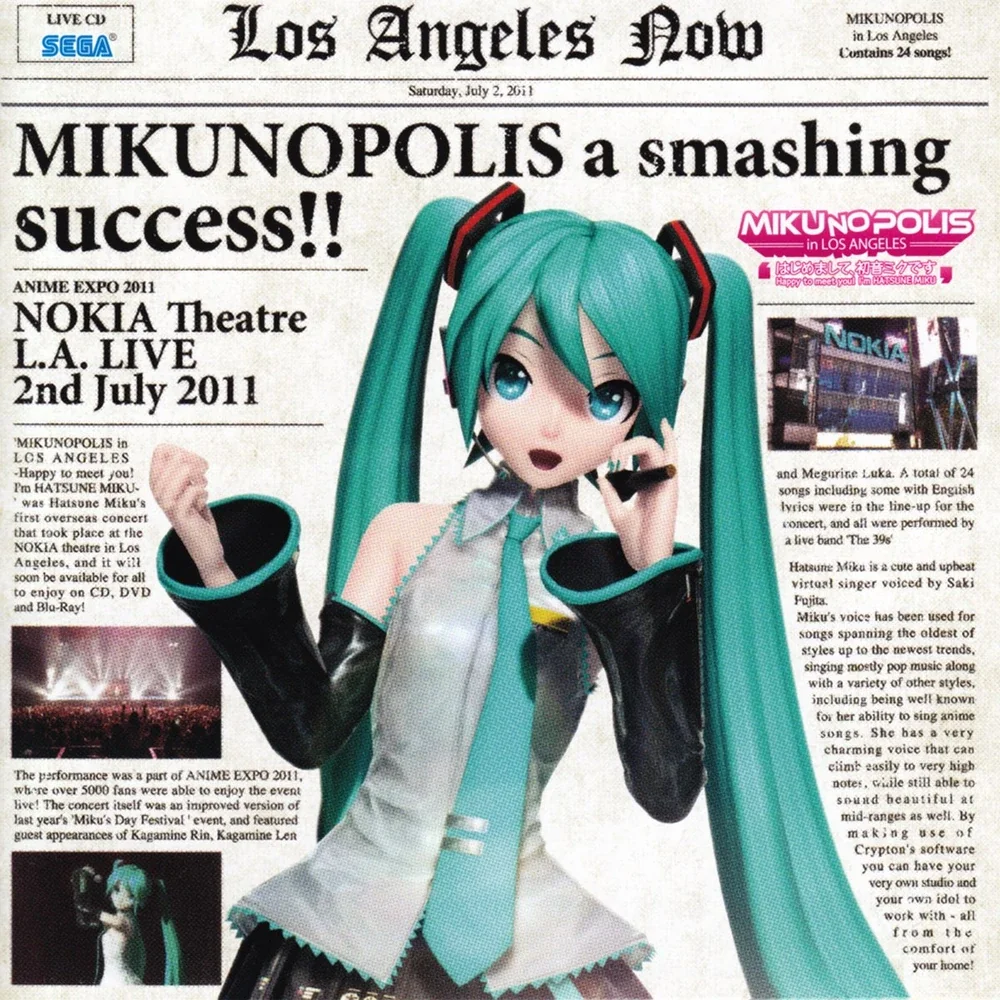
MIKUNOPOLIS in LOS ANGELES
BY Ian Hoffman
sunday school
MIKUNOPOLIS in LOS ANGELES
Sunday School takes another look at a classic album worth revisiting years after its release. EMMIE staff handpick releases that shaped a genre, defined a generation or deserve a little more recognition. Keep up with Sunday School for your weekly dose of dusted-off classics + throwbacks that merit a second spin.
first (初, hatsu), sound (音, ne), and future (ミク, miku)
Following Crypton Future Media’s release of the new vocaloid software bundle named Hatsune Miku, the blue-haired chibi girl waving a leek flooded the pages of Niconico (Japan’s YouTube). The virtual idol’s instant online success caused a terrifying and surreal result: she disappeared completely. Netizens searching for Hatsune Miku in October of 2007 were met with nothing. Not a single mention of the iconic Miku. She had been wiped clean from the internet. Her sheer virality had prompted her, in a unique glitch, to be marked as internet spam and removed from Google and Yahoo.
Four years later, however, a hologram of Hatsune Miku performed producer cosMo’s “The Disappearance of Hatsune Miku” in front of 3,500 in Los Angeles. This was Hatsune Miku’s first live event in the United States and the 24-song setlist was packed with a collection of the greatest vocaloid songs ever made – the songs that made her such a phenomenon worldwide.
What made Hatsune Miku so unique was the new culture of music production that used the software for more than just a replacement of a voice; the vocaloid was a chance to push music into the future, to exercise creativity past the limits of the vocal cords.
The 73-minute concert album underscores the bustling creative ecosystem that has cultivated entire lores and personalities for fictitious characters, and the 2011 performance was a collection of the powerful tracks that defined this movement.
A potent three-track suite in the set includes producer Vocaliod-P’s “1/6 -out of the gravity-,” which remedies an internal sorrow with the weightless feeling of the moon’s gravity. Following this track is the aptly named “moon” by iroha(sasaki) which compares Miku to the moon, both symbols that are not human but are deeply connected with the human experience. Finally, cosMo’s “The Disappearance of Hatsune Miku” explores the fleeting nature of an internet idol who has no heart or soul but is nonetheless content with being remembered as something more than just a software when she eventually disappears into obscurity.
This trilogy is followed by the introduction of Kagamine Rin and Len, a pair of vocaloids that perform classic duets like Nori-P’s “Butterfly on Your Right Shoulder” and “Meltdown” by iroha(sasaki). Soon after is a performance from Megurine Luka, the first with the capability to sing in both Japanese and English, a fitting artist for the first ever US vocaloid concert.
Tying off MIKUNOPOLIS in LOS ANGELES is the final track of the encore, “The First Sound” by malo. One of Miku’s earliest hits, this song testifies to the sound of the future, a new generation led by Hatsune Miku. While the genre of vocaloid is still widely misunderstood and its audience still primarily Japanese, MIKUNOPOLIS exemplifies the joy and spirit of a passionate community that has crafted a world around one fictitious character that continues to resonate across the globe.