
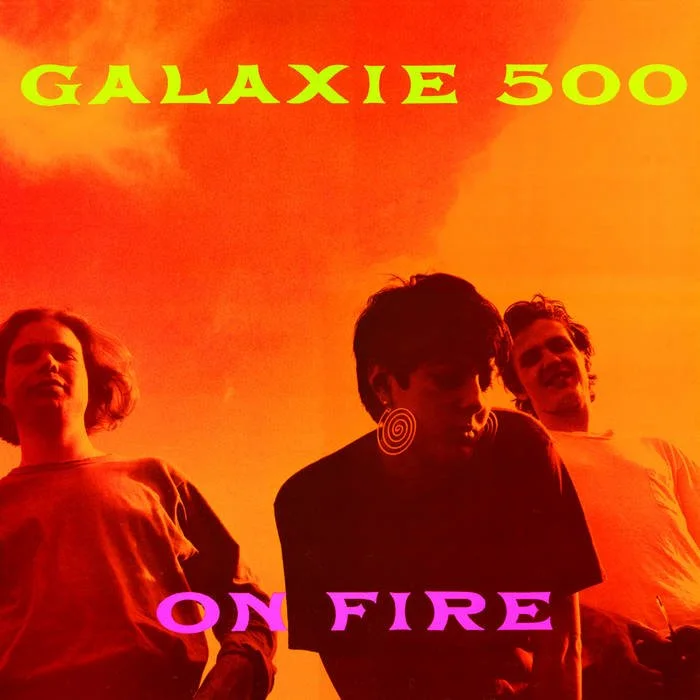
Galaxie 500 - On Fire
By: cole lampe
Sunday School
On Fire
Sunday School takes another look at a classic album worth revisiting years after its release. EMMIE staff handpick releases that shaped a genre, defined a generation or deserve a little more recognition. Keep up with Sunday School for your weekly dose of dusted-off classics + throwbacks that merit a second spin.
When discussing his musical philosophy, Lou Reed famously said, “One chord is fine. Two chords is pushing it. Three chords and you're into jazz.” Some fifteen years after that quote was uttered, Boston’s own Dean Wareham, Naomi Yang and Damon Krukowski arrived at the same ideology when forming their band, Galaxie 500.
While none of the three were exceptional at their respective instruments (an early incarnation of the band landed in dead last at Harvard University’s Battle of the Bands competition in 1983), they harnessed their limitations, and a bit of Reed’s philosophy, to their advantage, pioneering slowcore, dream pop, and shoegaze in the process.
Galaxie 500 debuted with 1988’s Today, an album chock-full of charming, lo-fi indie staples. While a great album in its own right, Today is most notable for proving that the band came out of the gate with a fully formed identity. With no intention to veer from their signature sound, all they could do was improve it. On their follow up, 1989’s seminal On Fire, they did just that.
Expanding on their dilapidated, jangly version of garage rock, On Fire slows down the tempo and cranks up the reverb, creating a surreal atmosphere. Krukowski’s relaxed, cymbal-heavy drum beats serve as the perfect compliment to Yang’s quaint, melodic basslines that tend to linger high up on her fretboard. Wareham blankets each track with layers of droning rhythm guitars and searing leads, distorting the tranquility of the rhythm section. His distinctive vocal melodies, often pushed to the top of his range, are uncomfortable yet strangely welcoming; it often feels like he’s earnestly singing at you through a set of clenched teeth.
This is most apparent on “Strange,” an album highlight and great example of the band’s ability to turn the mundane or absurd into something more introspective. Although Wareham has stated that this song was inspired by an experience dropping acid with his friends, the lyrics speak to the sense of feeling othered in universal third-spaces like drugstores and sidewalks. “Snowstorm” takes on a similar approach, expressing the sense of social isolation through the act of watching the weather report while snowed in.
Other songs, like “Blue Thunder” and “Leave the Planet,” employ bizarre and comical lyrics to convey the desire to escape from one’s surroundings, with Wareham optimistically declaring “I’ll drive so far away” in the former, and, in the latter, depicting someone headed to space deciding whether to bring their wallet or guitar.
Many critics have noted that the sound Galaxie 500 establishes on On Fire can get repetitive, with many of the tracks plodding along at the same sluggish tempo. While this assessment is accurate, the group’s dedication to their distinct sound emphasizes how singular their music was in the emerging indie rock scene. Though they may not have been writing lively, movement-defining songs like their Boston contemporaries Dinosaur Jr. or Pixies, their dedication to bizarre yet simplistic songs helped usher in new genres that pushed indie forward.
After releasing one more album, 1990’s This is Our Music, Galaxie 500 split in 1991 due to internal conflict. Not that it mattered much, for they had already laid the groundwork for the next generation of indie rockers, who would bring shoegaze, dream pop and slowcore to the masses. Although there has been a plethora of bands emulating this style in recent memory, what is shocking about listening to On Fire thirty-seven years after its release is how novel it still feels. Through their combination of the scuzzy garage rock of The Velvet Underground, the optimistic jangle pop of The Feelies and the proto-shoegaze of Cocteau Twins, the ten tracks that Galaxie 500 presents on On Fire exist entirely apart from anything that came before or after it. Despite their influence, there will never be another band that sounds like Galaxie 500; or another set of dream pop songs as important as On Fire.