The ROTTEN Issue: Excuse Me, Who Are You?
Words BY Soleil Rumpit, Photos by Joseph Frederick
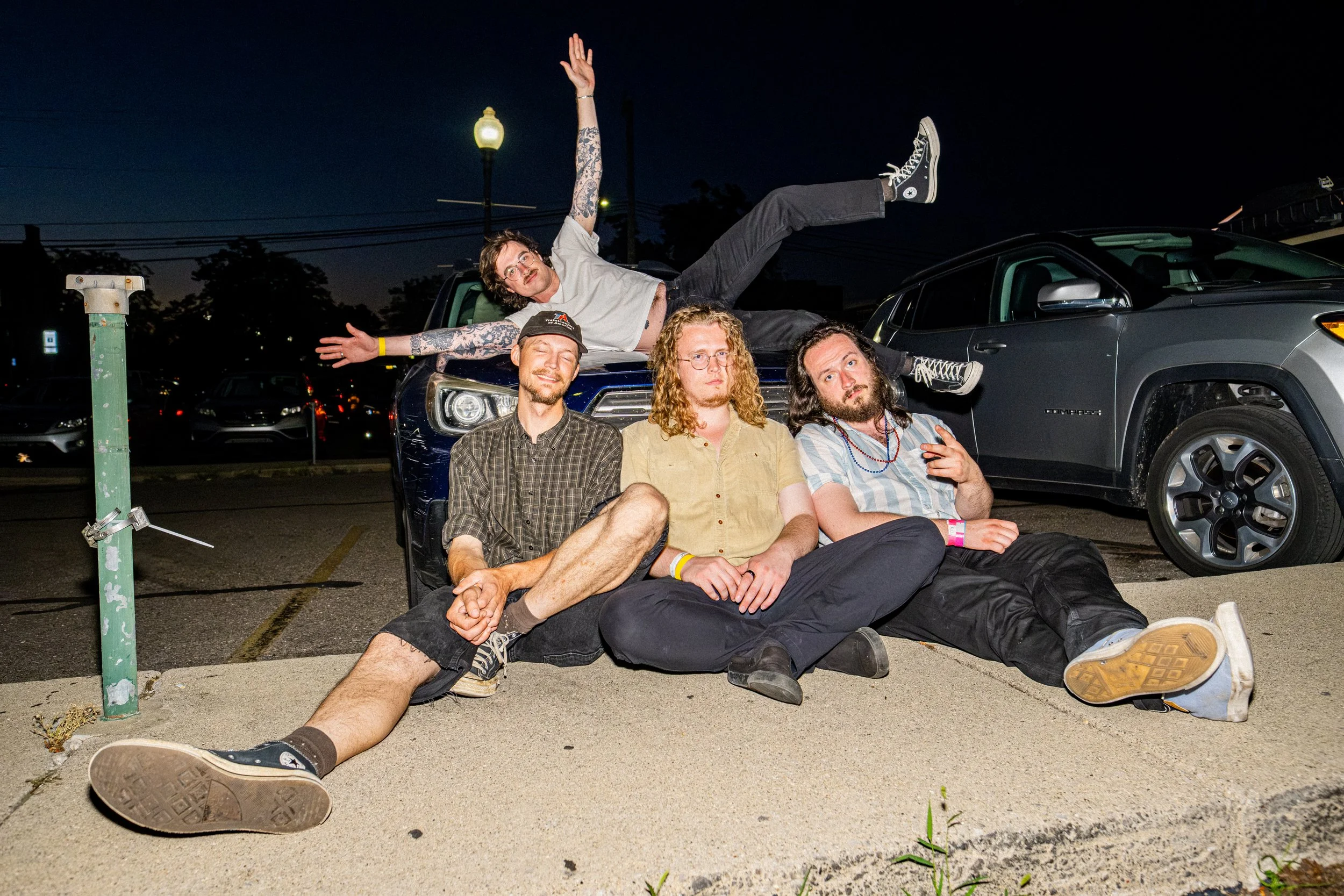
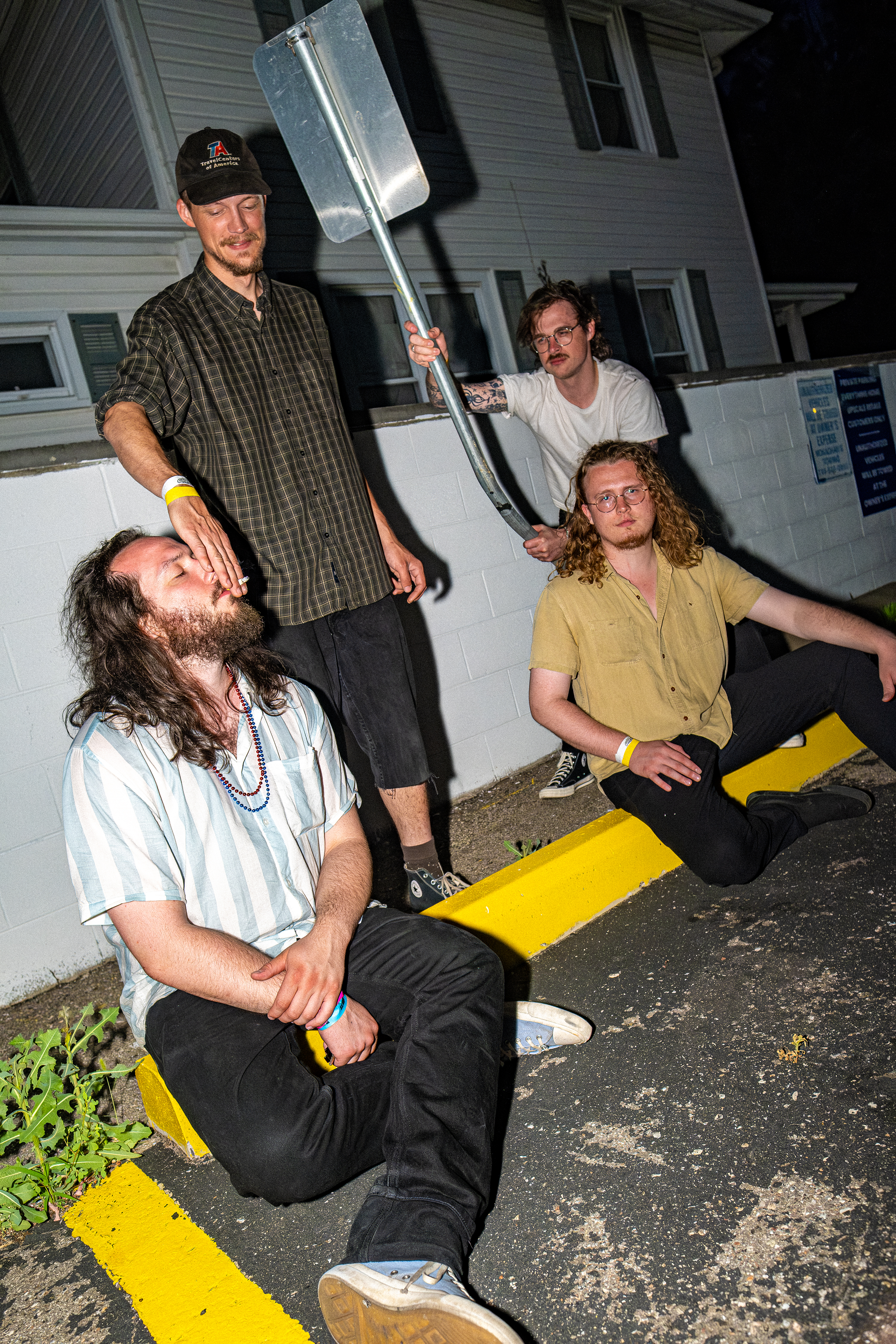
I sit down with Excuse Me, Who Are You? (EMWAY) in Brass Ring, a bar which serves as a pre- and post-show oasis for the musicians that visit the neighboring High Noon Saloon. The thrum of another band’s soundcheck bleeds through the walls; the click of cue balls will soon be swallowed by distorted guitar and amped screamo vocals.
It’s easy, in the bar, to read the group across from me as deliberately unserious, as they riff off each other and poke fun at their own music. When I invite them to play at a friend’s house next year, joking that it will be the worst venue in Madison, guitarist Stuart Benjamin replies, “That only makes us want to play it more. We’re the worst band in Madison.”
Onstage, however, that version of them is distilled into something more concentrated and much harder to read. Along with Stu on lead guitar, the band features Hayden Johnson on drums, Jackson Pertzborn on bass, and Kyle Kinney on vocals. EMWAY has been playing shows long before releasing anything full-length, cutting their teeth in beer-stained leaky basements, as is required of every budding Madison band.
Through the years, they’ve translated their offstage chemistry into something strikingly distinct and impossible for anyone tuned into the midwest emo circuit to turn a deaf ear to. That steady, word-of-mouth momentum accumulated into a devoted following who now pack into High Noon on a Sunday night, pressed right up against the stage, singing every word back to them.
Their debut album, Double Blind, is brimming with references to the 1997 Satoshi Kon film, “Perfect Blue,” which also provides the source of the band’s name (see track one: “EMWAY?”). Even beyond the many dialogue samples sown throughout the record, the shared themes between the two are hard to overlook.
“Perfect Blue” is obsessed with the fracture between who you are and who you present to the world. It continually blurs the line between what’s real and what’s performance, while exploring how those real parts of you can break down under pressure — or grief. EMWAY isn’t afraid to gnaw into the bruised and rotten core of these ideas, wearing romantic and familial loss unflinchingly.
Kyle mentions how the death of their father catalyzed an impossible range of emotions which drove much of the lyrical creation of the album. It’s hard to shake the thematic parallels from screenplay to lyrics: cyclonic life events spurring a splinter in self-identity, a warped perception of oneself and the world, and memories strong enough to destabilize the present.
The opening track reaches outward, asking “Will I find my rest like you?” and by the penultimate song on the record, that uncertainty has turned inward, the lyrics fragmented and piercing: “Sometimes I can’t tell if it’s you or me that’s dead,” and, finally, “What did I expect to find?”
Kyle explains, “I don’t know what else I would write about in an emo band, you know? Of course my lyrics will be about the shitty things that have happened to me. But it doesn’t have to be poetic – I want it to sound like I’m actually talking to someone.”
It forms an outline of their approach to composition as well as performance, particularly the embrace of emotion without exploitation. It’s easy to fall too far into analyzing the parallels to Perfect Blue, but the band’s creative process contradicts that kind of neat interpretation. As Kyle describes their approach to sampling, especially for the “Half-Life” soundbites on their 2022 EP, involves a lot of Stu “throwing shit until it sticks.”
“I think putting samples in songs is akin to when you’re in middle school and you put pictures of your favorite things on your binder, you know?” He explains, “And now it’s like, damn, maybe there was something profound in these.”
A lot of their musical composition seems to follow this more fluid approach. Guitar harmonies might be wrangled among them for a year until they reach a consensus and Hayden is able to work drums into the mix. Vocals and bass are usually the final additions, with Kyle and Jackson on occasion finding themselves writing up to the minute before recording.
EMWAY clarifies that they want to keep using samples, but they’re mostly done with the “Perfect Blue” and even the “Half-Life” references (if anyone can believe that). Their projects, at least so far, were never meant to be monumental, enigmatic concept albums. Even Meat Jelly, an earlier band that Stu and Jackson had belonged to, was built around being together and playing what they felt like.
“Mostly, we just wanted to get drunk and play music,” Stu says, with Kyle adding, “that hasn’t changed.”
It’s a reminder not to over-mythologize a band that has made such an impact locally — for all the way their sound has shifted, that core impulse remains; evolution is never presented as self-serious reinvention. Even as EMWAY’s sound grows more instrumentally complex or emotionally heavy, the band seems to approach it with a casual irreverence, more interested in the act of playing than building any fixed idea of what they’re supposed to be.
Still, authenticity is constantly put into question in music, especially so in the sphere of emo. Modern emo (or fifth wave, or post-emo, or wherever we are) may be one of the most derivative genres out there, maybe because of the clear lineage from its inception or from the heavily localized, community-driven scene that allows for a kind of aesthetic inbreeding.
“Everything is derivative,” Stu tells me, “It’s just that our music is derivative of the right things.” He credits the line to a friend, but it feels patently his.
A lot of their technical and emotional roots can be traced back to Iowa three-piece Stars Hollow, heard in kindred lyrics grounded in morbidity and vulnerability, as well as their similar prowess to jump from twinkly picking patterns to sudden, full-bodied swells.
EMWAY themselves are the first to admit the influence on their sound, with Stu telling me, “Everything we do is rooted in what Stars Hollow has done in the past.”
“Yeah, all ripped off,” Kyle laughs.
Stu tells me the story of seeing Stars Hollow play a house show nearly ten years ago that cracked the basement floor open like a fault line.
“That night, I bought their cassette and went back to Madison and showed all my friends. I was like, ‘Dude, this is the coolest shit ever.’ And they were like, ‘Yeah, man, this is midwest emo.’”
A lot of what EMWAY is today seems to have grown from that night, rooted in the grounds of midwest emo, but always eager to branch beyond it as well. Stu didn’t know it then, but years later his band’s debut album would circle back to that moment, with Tyler Stodghill of Stars Hollow featured on the second track, “Maybe That Truck Hit Me… And This is All a Dream…”
While EMWAY is quick to point out the music and people that have shaped them, they’re just as quick to leave space around the individual songs. Twice throughout our conversation Stu references filmmaker David Lynch, who preached the philosophy of letting art speak for itself. The band’s resistance to overexplaining their music doesn’t come from an egoistic desire to maintain mystique, but rather a selfless aversion to adding or taking away from something already finished, something so many people connect with in their own way.
That openness, along with their kind of reckless ingenuity, has allowed listeners to find themselves within the music – especially those lucky enough to experience the voltaic intimacy of an EMWAY show. Every project and performance has reinforced that fan faith, carrying their success well beyond Madison.
EMWAY has thundered into a landscape that had already seemed so defined, carving a new channel within only a few years. While they’ve become a stubbornly recognizable, one-of-a-kind force on the local scene, I don’t expect a band named after a line that questions identity to wane in the spontaneity and fluidity of their sound.
By the end of the night, the room at The High Noon Saloon feels smaller than it did before, the distance between the band and the crowd nearly dissolved. The same guys trading jabs over drinks were now locked into a red-hot intensity – though they’ll still be sure to drop a complaint about the amps at some point, just to take it back because “yeah, who gives a shit.”
Everything they’ve built, from attending house shows to hosting their own to selling out locally renowned venues, seems to be less of a solid trajectory and more a continuous evolution; they’re a band carried forward by a tireless love of making music and a midwestern DIY ethos instilled in them all those years ago. EMWAY lives in a scene that thrives on the familiar, but through their unrestrained creativity, their cutting vulnerability and a touch of flippancy, they always stay just off-center, just volatile enough to veer somewhere unexpected.