
Artist Feature: Emperor X
Words by Allie hoffert, photos by soleil rumpit, interview by oliver gerharz, allie hoffert & soleil rumpit

Chicago’s Roscoe Village celebrates its 19th annual Burger Fest on a smoky weekend in late July. Settled in the middle of the festival’s footprint, the Beat Kitchen hosts American-born, Berlin-based experimental folk/rock artist Emperor X (real name Chad Matheny) on the summer leg of his Unified Field Tour.
As we walk through parking lots and across busy streets towards the Chicago River, Matheny speaks candidly about his experience writing and recording Unified Field, his first album in four years. The album was largely recorded in Ukraine, where local artists added instrumentation and production. One percussive sound on the track “Also Unified Field” comes from a wooden Güiro shaped like a frog, recorded in a hallway darkened by a power outage. “I wanted it featured more. I wanted people to hear that sound, because the kid was so stoked about bringing it — like ‘oh, my grandma gave me this!’”
A few blocks out from the Burger Fest grounds, an explosion of undetermined origin sounds out. Matheny likens the sound to “a very small drone attack,” recollecting an air raid he experienced in Ukraine. “Our bus pulls in, all the street lights go off, you hear the air raid sirens [...] and I was like, oh God, I haven't found my hotel. There's no lights.”
“I’m nothing compared to some Ukrainian friends of mine. I don't know what the right word is for it, but I was in no danger — in the same way that any of these cars could kill us right now,” he says, gesturing to a wall of idling cars at a crosswalk. “There's a statistical possibility that any one of these cars will hit us, but they don’t, and we walk across. I think that's what air raids are like in Ukraine for the most part.”
More so than any other Emperor X project, Unified Field is blatantly political. Particular highlights include “Praise Jesus! Hail Reagan!” and “Line Go Up Line Go Down,” whose bridge asks “would you like an explanation of the chorus?” before a dialogue debating the utility of the United Nations and European Union, set against a driving drumbeat. “There’s no time for not being direct in 2026,” Matheny says.
Part of the goal of Matheny’s overtly political lyricism is to catalyze debate among listeners. “I started making music at a time when this wasn't as contested, but now what left and right mean are totally scrambled,” he explains, then recalls a group discussing geopolitics after his Detroit show, the night before our interview. “I don't see a whole lot of evidence of that happening naturally,” he says, “so I'm trying to be an annoying guy to make it happen whenever I can.”
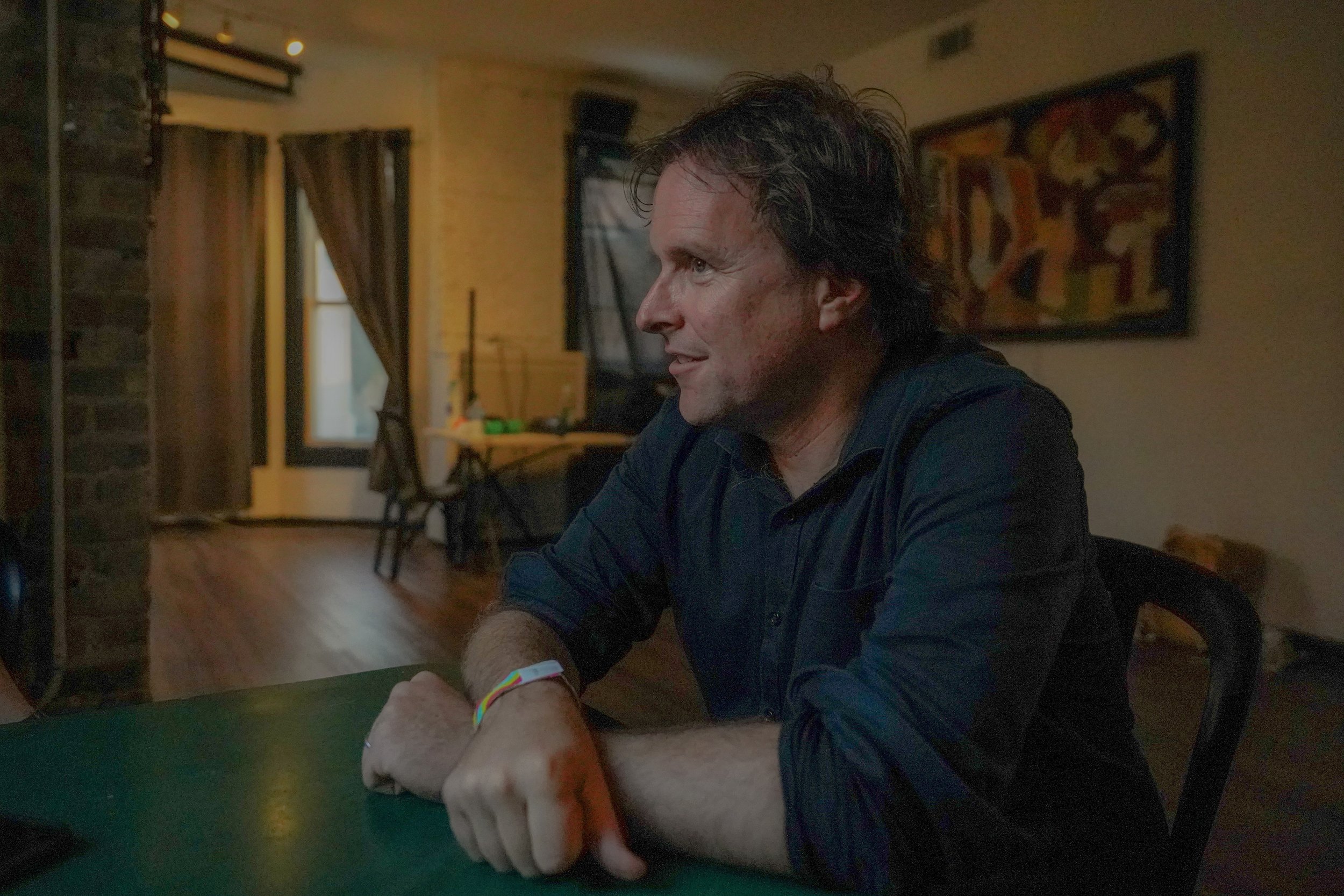
Matheny in the Beat Kitchen’s spacious green room.
When it comes to writing, Matheny’s literary philosophy is most aligned with imagism, a poetic movement from the early 20th century that emphasizes precise imagery and concrete diction as a method of expression. Citing Emily Dickinson, Geoffrey Hill and Ezra Pound as particularly influential, he describes poetry as “a device for making you feel something [...] it doesn’t have to be about something. A lot of poets operate this way, and I want to do lyrics that way when I can.”
Through his more ambiguous, imagistic writing, Matheny envisions his songs as devices for listeners to put together meaning. He points to “Erica Western Teleport,” the opener to Western Teleport and a recent sleeper hit online, as an example. “A lot of people write me and say, ‘I can't believe that you wrote about exactly this circumstance,’ and then they describe a circumstance that I was not writing about, you know, but there are enough little details, hooks. [...] and then they can connect the dots themselves. Meaning can be flexible. You can have a flexible meaning without it being meaningless.”

Matheny’s newest album, Unified Field, released on June 26, 2026.
For an artist with over a dozen albums under his belt, Matheny’s background is somewhat unorthodox; his professional experience includes a bachelor’s degree in physics, several half-finished graduate degrees and years as a science educator. He’s currently in the process of finishing a thesis on the aesthetically injurious nature of audio mastering.
Matheny points to his scientific background as “an arsenal, like weapons that I could pull out. It’s good vocab for poetry.” To him, creative and scientific pursuits are mutually entrenched — his perspective on the scientific world is enriched by his aesthetic and creative interests. “There are a lot of scientists with really good aesthetic instincts, but certainly a lot more in the 19th and 20th centuries than now. I think now we force STEM people to be only STEM. That feels weird to me.”
The same goes for his perspective as an artist. “If more artists knew science, if more artists knew rhetoric,” he says, “I think we'd probably be in a better world.” According to Matheny, reading “Dune” at a young age was the event that kickstarted his fascination with the intersection of art and science. “Science fiction, I think, is probably some of the most important artistic work that people can do. There's a very, very nearly related parallel universe where I was a sci-fi author, not a musician. I'm very sure of that.”
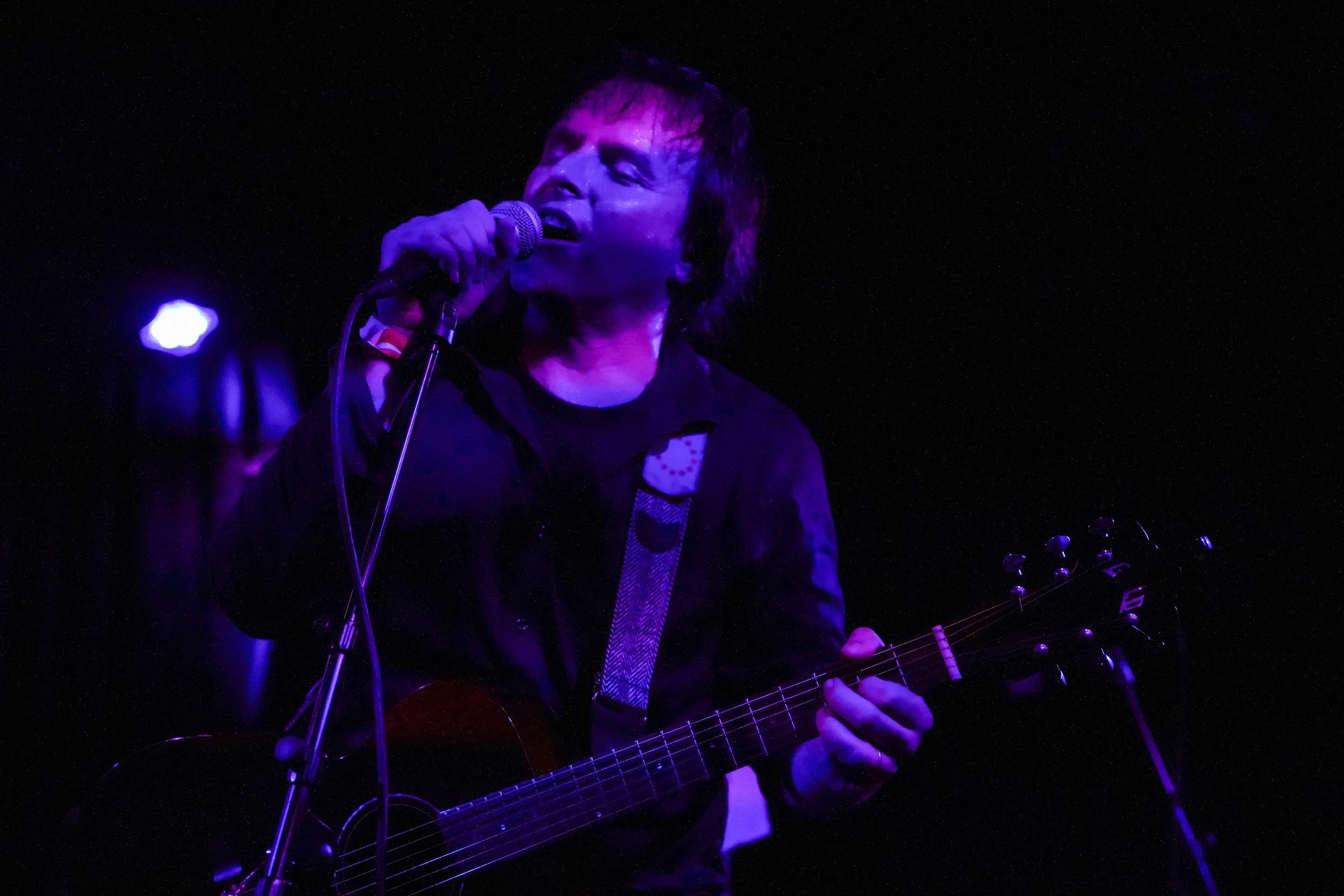
The Emperor X show at the Beat Kitchen featured three sections: new songs from Unified Field, requests and classics.
Regarding the future, Matheny isn’t sure a total end of the world is likely, but he believes that a “moderate quasi apocalypse” consisting of a total hard drive wipe is easily possible. “Somebody could press a button and delete Spotify.”
For long-term music preservation, he believes in two routes — one, “the Muslim model — everybody memorizes a little bit of the Quran. [...] You can't memorize the whole thing, but if you get a hundred Muslims, they memorize one hundredth of the book, or one 50th or one 20th or something, statistically, eventually, you're gonna get the whole book.”
“The other method,” he says, “is physical — metal records.” The PVC currently used for records is fragile, but metal masters are far more durable. “My main motivation for putting records out is that people will still be able to listen to it with a hand crank turntable.”
Matheny wants future generations of music listeners to “be able to experience audio in the way that we do, and not have to guess” when it comes to rock music. He explains the philosophical notion of the ontological primary — the idea of something that captures the original, intended experience when it comes to music.
“In classical music, it's the score. If you have a classical piece and you've got the score, there are many different possible interpretations and it's still the piece. In jazz music, it's the performance that matters. You could have the same song, doesn't really matter who composed what you're playing, it matters how you're playing it in that moment. In rock music, audio is the ontological primary.”
For the release of Western Teleport in 2011, Matheny buried 41 tapes across North America, some of which were uncovered by fans, and some of which remain hidden. Left underground for decades, tape cassettes might not be as functional as metal records, but Matheny’s act of burying the tapes is more of a statement on music preservation than an attempt at it. He sees it as a “comment on legacy, being able to make something last.”
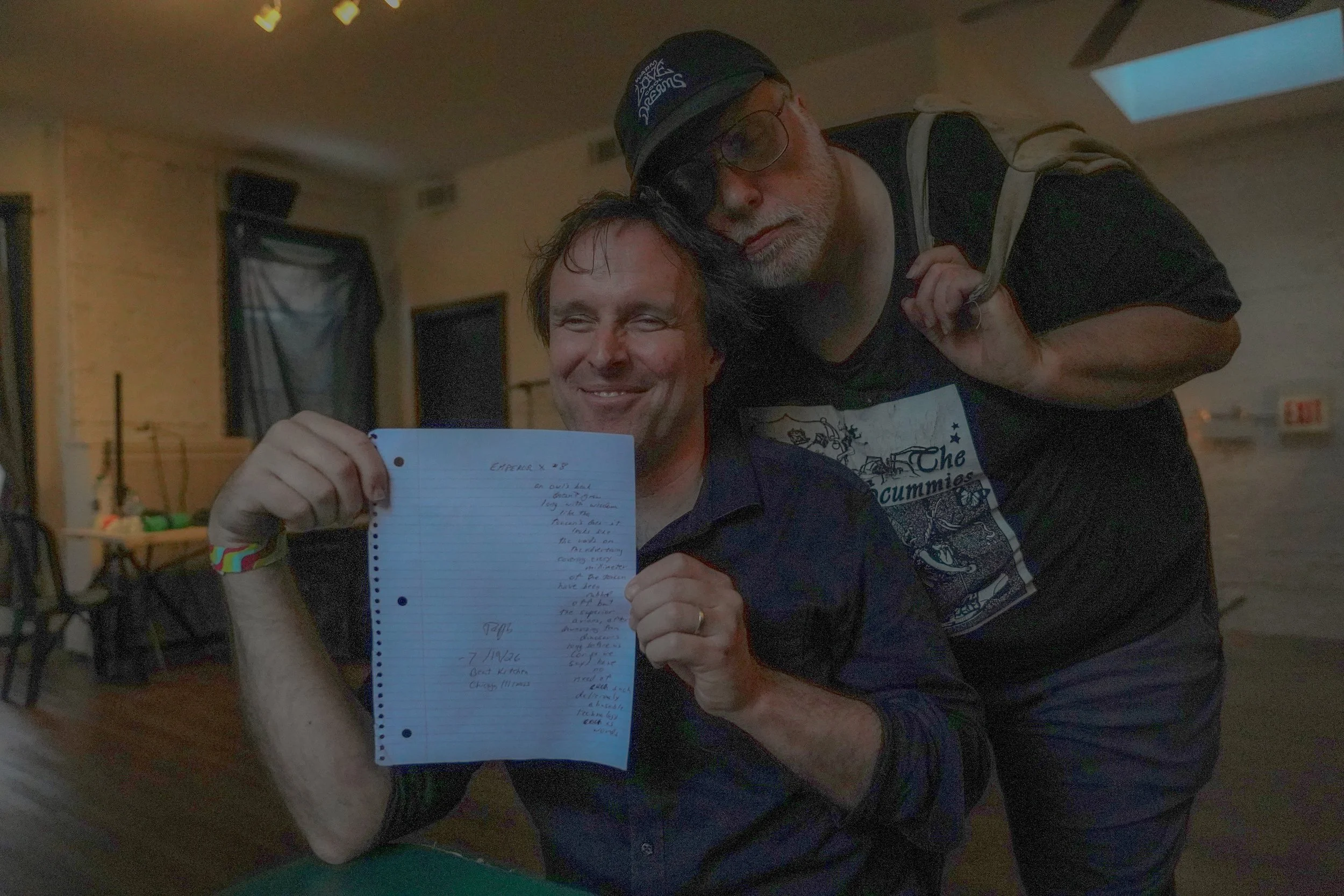
Emperor X #8
an owl’s beak
doesn’t grow
long with wisdom
like the
toucan’s does – it
looks like
the words on
the advertising
covering every
millimeter
of the toucan
have been
rubbed
off but
the superior
avians, after
downsizing from
dinosaurs
long before us
(or so we
say) have
no
need of
such
deliciously
abusable
technology
as
words…
- Thax Douglas
7/19/26
Beat Kitchen
Chicago, Illinois
Matheny and the poet Thax Douglas (both pictured here with a poem for the show) have known each other ever since Douglas was the sole attendee at one of Matheny’s earliest Chicago shows.
Matheny traces his fascination with audio recording and preservation back to his roots; he recounts a childhood conception of recording on tape as a way of “speaking to the future,” leaving a message in a bottle for himself or others ages down the line. “I think the idea of the immediacy of the past is really fragile,” he explains, drawing comparisons between Sufi mystic poet Rumi and Silver Jews frontman David Berman. “If you read [them] side by side, they sound really similar. I think they were on the same stuff.”
There’s a certain timelessness that suffuses Matheny’s work, even on Unified Field. The narrator of “Superbus” (a character duped by “fake enlightenment for young liars” staring through rain-soaked cliffs from a trailer on the edge of the sea) calls to mind the disillusionment of any number of 20th century modernists. “Ostrich Toss” feels like a story that could have been adapted from a centuries-old fable. It’s easy to imagine an eccentric music nerd a century in the future listening and connecting to Unified Field, with its depictions of invisible hands on youth crusades and patron saints of airports.
Like Rumi, David Berman, Emily Dickinson, Frank Herbert and every one of his literary, musical and aesthetic influences, Chad Matheny writes for the future just as much as he does the present, leaving proverbial messages in bottles (or MP3 files, or tape cassettes, or metal records) for future generations. “I want people to know in the future that we were like them,” he says. “I think they'd be very excited about that. I think it'd be good for humanity. [...] Space colony art is going to exist. Mars art is going to exist. I want people to know that we were like them.”